Thursday, December 19, 2013

Techno Warriors


1997
Director: Phillip Ko Fei
Starring: Darren Shahlavi, Kwang-su Lee, Monsour Del Rosario, Tamara Guo, Winston Ellis

I nearly didn't bother with this movie. About a year ago, I tracked down a 1999 sci fi/action film called Digital Warriors (aka Lethal Combat) soley because it featured Yukari Oshima (in case I haven't made it abundantly clear in this blog, absolutely anything that features The Osh is a must-see). Well that film turned out to be a turgid little mess as are most films directed by Phillip Ko. The best scenes (other than Yukari's) I later found, were actually lifted from an earlier film called Techno Warriors. Since that film was also directed by Ko and doesn't feature Yukari, I initially had zero interest in seeing it. Still, that swiped footage WAS entertaining and when a trailer finally popped up on Youtube, I decided to ignore my gut and check it out. As it turned out, that was a good move as Techno Warriors surprisingly wound up providing me with big time low budget fun. 

An inversion of Tron by way (visually) of those wonderfully cheesey low budget Italian Mad Max ripoffs of the previous decade, our story tells of a group of outlaw techno warriors (with names like Black Ninja and Dinosaur) fighting in the video game realm. They are anti technology (for whatever reason) and are hunted by high tech police. The techno warriors' goal ultimately is to kidnap a nerdy video game player and take him to their realm. Since he is able to consistently defeat them in the gaming world, they want to probe the secret of his gaming skills to control the gaming network... or something close to that.

The plot is about as irrelevant as it gets. Shot in the Phillipines, the purpose of this fun flick is to show off as many battles in as many exotic locales as could be found and to that end, it works quite wonderously. This film is exactly what the disappointing Mortal Kombat series should have been. In fact, it may be the best realized video game film ever made. The low budget (which includes minimalistic costumes and cheap laser effects) actually adds a level of wide eyed innocent charm that more expensive CGI enhanced epics can't begin to grasp. The group of fighter/acters (led by the talented Darren Shahlavi, going against type as the main hero) give it their all without a hint of self concious parody. They treat the material seriously and the film benefits greatly from it.

By far the best thing Ko has ever done as a director, Techno Warriors is pure untaxing entertainment and a joy to watch.


Rating: 8/10


.

Monday, December 9, 2013

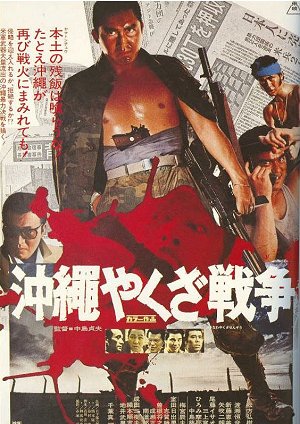
Okinawa Yakuza War


1976
Director: Sadao Nakajima
Starring: Hiroki Matsukada, Shizumi Shindo, Sonny Chiba, Tsunehiko Watase, Isao Odo

What's this? A 70s ultraviolent Japanese Yakuza pic that opens with an over the top Sonny Chiba karate smackdown? Cinema nirvana achieved? Well not quite, but damn close...

The premise; a grand yet unstable alliance is formed by various feuding Okinawa gangs in order to fend off a new and aggressive Mainland mob that is encroaching on their collective territories. This fragile allegiance finds itself shaken by volatile (to put it mildly) right hand man (Chiba) who along with having an apparent death wish, deeply resents the new civil ("cowardly") ways of his associates and seeks (with fist and foot) to destabilize all involved.

Into this volcanic situation, director Sadao Nakajima crafts a visceral and emotional roller coaster ride of comic book-like carnage. On display, we have a particularly agonizing castration scene (like there's any other kind), a rival gangster getting run over and backed over... and back and forth and back again... and forth again, blood squibs galore, double and triple crosses that cause one to rethink whom they should be rooting for (if anyone) and a terrific and emotionally satisfying speedboat shootout finale. At the center of it all is Chiba who despite not being the main character, steals every frame he's in while giving what may be the most animalistic perf of his career. Picture the Terry Surugi character if he were to willingly dive into the abyss and you have a fair idea of what to expect here. Always intimidating and willing to get into anyone and everyone's face (including doing karate forms in a nightclub in front of rivals, just DARING them to do something about it), he achieves a certain nobility despite his inherent despicableness. It is to Chiba's and Nakajima's credit that one feels just a slight bit of sympathy when this character is ultimately betrayed and ambushed. It is almost akin to watching King Kong get shot off the Empire State Building.

Okinawa Yakuza War is an eye-opener that will appeal to Chiba fans, Yakuza fans and general 70s style Japanese action enthusiasts alike.


Rating: 8/10


Monday, October 7, 2013

The Mummies of Guanajuato


1970
Director: Federico Curiel
Starring: Blue Demon, Mil Mascaras, El Santo, Elsa Cardenas, Patricia Ferrer, Jorje Pinguino

One of the best of the Lucha Libre films as well as the single most popular and profitable. It's not hard to understand why as it teams no less than the three most popular masked Mexican wrestlers of all time and pits them against an army of monsters (a creepy, real life tourist attraction come to life) that really hit home with the local population.

As most Lucha Libre fans know, 'The Mummies of Guanajuato' was originally planned and scripted as a two player co-starring Blue Demon and Mil Mascaras. Then just as filming was about to begin, El Santo was brought in and the script was changed to allow him to come in in the final reel and be the main hero. Mil didn't mind this at all as he saw more money being made with this move, but Blue was furious. The bitter rivalry that he and The Man in the Siver Mask shared in the ring finally poured out behind the Silver Screen (though fortunately not in front of it). For the duration of the movie, Blue and Mil were repeatedly defeated by the army of rampaging mummies (even going so far as to have one of them knock Blue out cold and steal his mask and costume so that Blue would mistakenly be blamed for it's crimes; oh, the indignity!) only to play final reel second bananas to Santo who not only fared better fighting the mummies, but is the one who figures out how to ultimately destroy them (always convenient to carry a trio of flame throwing pistols in your car!). It's easy to understand Blue's resentment.

That aside, the film is terrific fun. It may be a slow go in the early reels, but it gets cracking when it needs to. The mummies themselves are merely wrestlers with pull over fright masks, but director Federico Curiel utilizes them for maximum impact and they truly are an intimidating bunch. Said mummies are also helped by a welcomed unpredictable script that allows them to kill off characters that normally would survive in these genre outings which when combined with the fact that they are based on a real life exhibit, must have lead to a genuine feeling of insecurity for first time audiences. The finale in which our heroic trio makes a final stand against the seemingly invincible army of the undead, is perhaps the single most memorable Lucha Libre moment on film. It's a sequence that's aided by a matador-like theme that puncuates the action perfectly (though sadly, it can't take away from the absolutely awful organ theme that's inexplicable used for the opening and closing credits). Speaking of odd music, there is a particularly bizarre mid-film musical number in which Blue and Mil are serenaded by what can only be described as a group of Robin Hoods playing mandolins! Isolate this one sequence and you have a music vid clip that will leave you speechless. 

Despite being incinerated, the Mexican mummy army proved to have great staying power (especially when the box office warrants it) and they returned in several increasingly horrific (and decidedly more adult) sequels. This first entry however, remains the most memorable and the most fun. 


 Rating: 8/10


Thursday, September 12, 2013

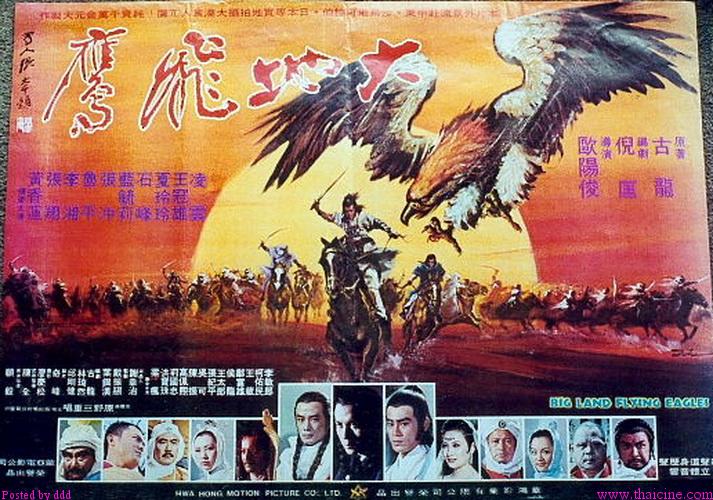
Big Land Flying Eagles


1978
Director: Ulysses Au Yeung
Starring: Wong Goon Hung (Champ Wang), Lin Yung, Paul Chang Chung, Shi Feng

 Here we have an interesting, well crafted and visually unique wuxia film.

The complicated plot centers on traveling swordsman supreme, Xiao Fong ( the awesomely labeled Champ Wang). Xiao killed the son of local warlord, Lee Sang. Lee was charged with the delivery of 3,000,000 in gold which has mysteriously vanished. Lee marks Xiao for death, but Xiao finds himself in an unlikely alliance with another reputable swordsman, Killer Eagle as well as a band of traveling Mongolian warrior/traders. Despite his target's new found comrades, Lee sends all manner of esoteric assassins out after him. Xiao for his part, gets involved with a mysterious woman who has manged to make many an enemy in her own right.

I'll admit that I've not seen as many classic wuxia movies as I have other types of Chinese martial arts/action films. Part of the reason is that many of the ones that I have seen tended to be overly complex and narratively confusing, at least to this Westerner.  'Big Land Flying Eagles' could easily have succomed to these same problems, but thanks to some sharp direction from Ulysses Au Yeung (a favorite independent 70s director responsible for several gems, most notably the previously reviewed 'Thou Shall Not Kill... But Once), I had little problem dissecting the complex story and characters. This is also one of the most visually striking martial arts films I've seen from this period. Shot entirely in the desert, the film creates an epic feel in spite of it's low budget. Almost a kind of 'Lawrence of Arabia'-lite (O.K. extremely lite). It's very pleasing to the eyes and creates a wonderful semi-surreal atmosphere throughout. It's quite a quirkily plotted film as well, including one of the most strikingly bizarre dramatic sequences to be found in any genre film; Xiao Fong and his mysterious squeeze are hiding out in a deserted shack when they find themselves surrounded by Lee Sang's gang. Xiao realizes that since he killed Lee's son, Lee wants the two young lovers to procriate (as in right there in the shack) and will wait one year for their child to be born and then have it killed in order to exact revenge. The shack is then ripped down by the unseen assassins so that they could see what they're doing! Xiao and the woman do not react to their sudden lack of shack. They continue to lie there in the night time forest and smile at the silliness of this failed plan. It plays just as outrageously matter-of-fact as it reads.

Featuring a terrific action sequence finale, 'Big Land Flying Eagles' is a wonderful min-epic of 70s martial arts cinema and comes highly recommended.


Rating: 9/10


Wednesday, August 28, 2013

Marked for Murder


1994
Director: Lee Chiu, Tenky Tin Kai Man
Starring: David Lam Wai, Ben Lam Kwok Bun, Liang Chia Jen

This appears to be a peace offering from Hong Kong to the Mainland due to the up and coming change of ownership. Judging by the several unfamiliar faces and two directors, this may even be a Hong Kong/Mainland co-production. Whatever the case may be, it's a little seen pic that combines unfortunate and unnecessary comedic characters with some of the most blistering 80s style action to be had in the 90s.

A bank employee witnesses the murder of his boss at the hands of a powerful Yakuza gang and it's nearly invincible leader (Ben Lam). On the run, he is guarded by a male and female member of a Mainland Task Force who in turn, must cooperate with a bumbling Hong Kong detective (David Lam).

Assuming that this production is indeed Hong Kong's attempt to make nice with China, then it represents a fair amount of overkill in that department. The two Mainland operatives are portrayed as calm, smooth and highly efficient while their H.K. counterpart (the usually reliable David Lam who is miscast here) is in the words of his superior, kind of dumb. That he has also an annoying, shrewish wife certaintly doesn't help matters. In fact, when said wife is ultimately kidnapped by the Yakuza, I was hoping that would be the last we heard of the character (no such luck). The goofiness also extends to our hero's superior/ brother in-law (a thankless non-fighting role for "Beardy" Liang Chia Jen who perhaps tellingly, is clean shaven for the role). Is is a credit to both Lam and Liang that their characters still manage to retain their charm and likeability (if less so, their dignity) throughout. Always relaible Ben Lam is suitably menacing and imposing as the head Yakuza.

Despite the uneven treatment of it's characters, the film really comes alive when it counts in the spectacular and plentiful action scenes. After personally suffering several years worth of wire fu films, 1994 turned out to be quite a renaissance in the stay on the ground and fight department. So fantastic is the action here that I can forgive much (but not all) of what goes on in between. There are others who might be less forgiving.


Rating: 5/10


Friday, August 23, 2013

Pendekar Liar


1982
Director: Dasri Yacob
Starring: Willy Dozan (Billy Chong), Winnie Aditya Suherman, Sutrisno Widjaya

 Billy Chong, the kung fu superstar that almost was. I became an instant fan of the Indonesian born actor ever since my first T.V. exposure back in the mid 80s. One of the most accomplished fighters the martial arts film world has ever seen coupled with natural charisma and strong screen presence, I was always curious why his star never rose beyond the also-ran group. Depending on my mood, I might even go so far as to say he is my favorite fighter/actor not named Bruce Lee. Unfortunately until only a few years ago, I had zero knowledge of Billy's post HK work (to the point where I wasn't sure he even had any). That however, didn't disuade me from penning an embarsassingly incomplete article about him in an old issue of Asian Cult Cinema magazine, circa 1999. I have since discovered that the reason (the given reason, anyway) for his abrupt departure was the disappointing commercial failure of the big budgeted, Sun Chung directed epic, 'Wind, Forest, Fire, Mountain' (aka A Fistful of Talons). He returned to his home country and did indeed resume a movie and T.V. career there under his birth name, Willy Dozan. 'Pendekar Liar' I believe was the first of them.

For the second time in a row, I'm attempting to critique a film that does not contain English subtitles. The previous blog entry, 'Jiu-Jitu' was relatively easy since the storyline was so simple and straightforward. 'Pendekar Liar' proved to be a tad more difficult. Fortunately, I just recently came upon a plot rundown that I was able to translate into very broken English. Hey, better than nothing...

In the film, Billy plays an orphan named Annga (which somehow translates to "CyberNet"!) who has been raised since birth by an old martial arts expert named Cokro and taught the the martial art, Silat (I think). Time and time again Annga attempts and fails to defeat Cokro (reminicent of the teacher pupil scenes in Drunken Master and Chong's own Crystal Fist). Nevertheless, Annga is sent away (with Cokro's loving daughter in tow) to seek out his mother (it has to do with the necklace he's wearing) and solve the mystery of who killed his father.After many adventures (which allow Chong as many chances to fight as possible, most notably taking on a karate school and their ringer, a nearly indestructible fat woman). Annga discovers that it was Cokro himself who caused his family's death... or so he thinks. Cokro as it turns out, has an identical twin...

I've seen my share of Indonesian action/martial arts films of this vintage and entertaining as they are, the actual fight scenes tend to be below the level of those found in Hong Kong. 'Pendekar Liar' for the most part, bucks that trend with some well above average choreography and this is almost certaintly due it's established star. I'm not certain if Chong's participation extended to choreography but judging the heightened level of combat here, I think it's safe to assume that it did. The fights may not quite be as lightening fast as they were in his Hong Kong pics like 'Super Power', 'Kung Fu From Beyond the Grave', 'A Hard Way to Die' and  the aforementioned 'Fistful of Talons', but they're close. Sure, Billy still appears here as a man amongst boys, but it's clear that his incredible martial abilities rubbed off on the production.

If there was a letdown to be felt, then it was in the finale. Though it does work on a dramatic level regarding the dual identity revelation (if anything, the drama and comedy are both handeled with more subtle flare here than in it's H.K. counterparts), it falls somewhat flat in the action department (the big deal being Billy's newly mastered technique which causes him to give off a strobe effect similar to Bruce Lee's famous arm movments vs Petrov in 'Fist of Fury' or Nemuri's Full Moon Sword stance in the later 'Son of the Black Mass' films). But it became clear that Billy had to ease off against his opponent (picture Jackie Chan having a final confrontation against Yuen Siu Tien's evil twin rather than Hwang Jang Lee for the climax of Drunken Master and you'll get the idea) making it feel less exciting than it might have.

That aside, 'Pendekar Liar' is a great find for we Billy Chong fans among who had precious few H.K. vehicles to choose from. Now I'm off to hunt down the rest of Billy's homegrown product...


Rating: 5/10


Monday, August 12, 2013

Ju-Jitu (aka Jiu-Jitu vs Karate)


2010
Director: Hiroki Asai
Starring: Ryohei Sakai, Koji Nakamura, Chikaomi Miyamoto, Yi Nan, Yasuaki Kurata

A no-budget, shot on video pic from Japan that just happens to contain some of the finest and most realistic empty handed combat sequences ever lensed.

The story is one big, hoary cliche about a nasty karate school challenging a noble jiu-jitsu dojo. Compounding the over simplistic story is some embarassing overacting from the villains and bland, near non-acting from the heroes, leading to some unintended laughs where there should have been tense drama. This however isn't surprising when you realize that real martial artists were used for all the main parts and they quite obviously never went to a thesping class.

But never mind any of that, 'Jiu Jitu' is all about the plentiful fighting and training scenes and are they ever an eyeful. Long time genre vet Yasuaki Kurata oversaw the project, producing and choreographing it as well as playing the wise jiu-jitsu sensei. Even in his 60s, Kurata has lost none of his physical prowess or screen presence. Star Ryohei Sakai may not quite cut it in the dramatic scenes, but once the combat comes into play, he "switches on" like the best of them and you believe he's the real deal (which essentially, he is).

The action is at a consistently high level throughout, but Kurata and director Hiroki Asai save the best for the finale. The near fifteen minute (!) showdown between Sakai's jiu-jitsu style and the karate school's top student (played by Koji Nakamura) is an absolutely blistering, exhausting tour de force that just may be the single finest one on one bout ever commited to film (er, video). So btutal, so thorough and so  draining is this bout that it left me gasping... and then rewatching it just to make sure it held up on repeat viewings (it most cetaintly does).

For all of the film's shortcomings, the final bout in 'Jiu-Jitu' automatically elevates it to recommended status.


Rating: 5/10


Here you can watch the final bout and judge whether or not I exaggerated about just how incredible it is: