Sunday, October 30, 2011

Little Red Riding Hood and the Monsters (Caperucita Y Pulgarcito Contra Los Monstruos) (aka Tom Thumb and Little Red Riding Hood)


                                                              1962
                                            Director: Roberto Rodriguez
                   Starring: Maria Garcia, Cesareo Quezadas, Jose Elias Moreno

                                      
Ooooh boy, where do I start with this one? This 1962 release was the third in a series of mind numbingly warped Mexican variations of the Little Red Riding Hood tale. Designed as a musical comedy horror tale for kids, it quickly developed a well deserved reputation as one of the most jaw dropping pieces of screwed up cinema ever made.

Here's the setup, kiddies; The Queen of Badness (who appears to have been inspired by both The Evil Queen in Snow White and the 7 Dwarfs and The Wicked Witch of the West in The Wizard of Oz) has gathered all the monsters in the world. Among them are the Vampire (which looks to have been modeled after John Carradine's Dracula in House of Frankenstein and House of Dracula), Frankenstein's monster, Bluebeard, Carrothead, Father Hurricane, the Siamese Twins and the Killer Robot (the same suit that was used in Robot vs. the Aztec Mummy and also appeared in Ship of Monsters). Their objective is to capture and kill the last two decent humans, Little Red Riding Hood and Tom Thumb. In order to lure them into The Queen's haunted forrest lair, they have captured two of their friends, the Ferocious Wolf and the Red Headed Ogre and are using them as bait.

The above synopsis cannot begin to do justice to the mesmerizing insanity that transpires during it's 85 minute running length. I have seen plenty of whacky films from South of the Border, but nothing to compare to this er, monstrosity. Just the way it opens alone is indescribably insane. The credits play as if it were a full blown horror film. The forboding narration only adds to the uneasiness. Then without skipping a beat, the monsters perform a musical number. The entire film plays like this. It's really quite something to behold.

To add to the madness, this was one of the Mexican fantasy films that was dubbed and imported by the infamous K. Gordan Murray. Murray had previously unleashed other Mexi horror movies as well as a couple of El Santo films (whom he redubbed Samson). Murray's dubbing always seemed like it was being broadcast from another galaxy. Well, K Gordon outdid himself with the Red Riding Hood trilogy by dubbing the many musical numbers that appeared in each film. These numbers were bizarre enough in Spanish, but when dubbed in Murray-English, they produce something approaching an out of body experience. The "highlight" are the numbers performed by Red herself (played by little Maria Garcia). Mr. Murray saw fit to dub her with what sounds like a 50 year old opera singer! It just may be the most disconcerting thing in the entire film (and that says a ton).

One thing that all will likely agree upon is that love it or hate it, there is absolutely nothing else quite like Little Red Riding Hood and the Monsters.

                                                           *** / ****


Sunday, October 23, 2011

Thou Shall Not Kill... But Once (aka Shaolin Warrior) (aka Ferocious Monk From Shaolin)


                                                               1975
                                               Director: Ulysses Au Yeung
                                 Starring: Chen Sing, Chan Hui Min, Kam Kong

                                    
Not only is Thou Shall Not Kill... But Once one of the greatest film titles in the history of action cinema, but it was also one of the earliest filmed Shaolin/revenge tales and having seen this 1975 micro budget Shaolin tale for the first time only recently, I was surprised by just how original and vital it still is.

During a funeral procession for a high ranking official, the family is ambushed by a rival official (played by Kam Kong) who wants the family's sword (said to be the most powerful in all of China). He murders the widow and has the rest of the family massacred. The son (Chen Sing) manages to escape. he spares the life of a guard that was pursuing him, impressing the Shaolin Abbott who happened to be watching. He is then allowed (after being rigorously tested) to become a Shaolin monk, renouncing his past. This doesn't sit well with his extended family (who have arranged for the once royal son to be married) or his beautiful wife to be (played by the lovely Lu Shu Chin). Internal strife within the temple also rears it's head in the form of the jealous top student monk (Chan Hui Man) who slowly finds his personal desires mentally intruding into his purified life.

While some fans may be put off by the lack of abundant action, I was extremely impressed with just how much depth (both in it's story and characters) it allowed within it's scant 82 minute running length and much of the credit must go to the note perfect direction by Ulysses Au Yeung. This includes a surprisngly frank depiction of sexual repression which is first shown during Chen Sing's initial test. In order to enter Shaolin, he must first meditate for 49 days. During this time, his mind wanders toward his spurned bride, but with big brother Chan Hui Man guiding him, he survives. Chan himself as it turns out however is not faring as well. He was very much aroused by the sight of the beautiful ex bride and has to fend off his feelings for her. At one point (in a bid of farewell), she clips off some of her hair and tosses it at them. Chen is unfazed, but Chan is clearly turned on by her scent. I was also very impressed with the reference to Bhodi Darma and how it ultimately relates to and parallels Chan's predicament (without giving too much away).

Both Chen Sing and Chan Hui Man turn in top work. Chen (with his gruff appearance) could seem cast against type as the quiet and studious monk in the making. But he pulls it off beautifully, showing a level of restraint to his performance that I hadn't seen before. Chan puts in arguably his best ever performance as the conflicted "big brother" who finds himself slowly consumed by feelings of lust and power. His is easily the most compelling character in the film. As the head villain, Kam Kang is decent, but nothing exceptional. Kam has appeared in a great many early seventies kung fu films and I've always come away underwhelmed by his performances.

When the action does happen, it is quite good. This could be considered an early Shapes (or Styles) film as it delves into the Shaolin 10 Animal styles (which are 5 more than I was aware of), but does not devolve into patty cake fu. The battles are still of the raw and harsh variety displayed in the earlier Bashers, making this film something of a hybrid which I found very pleasing to watch. The finale could have been a little longer and more drawn out, but that's really nitpicking.

Thou Shall Not Kill... But Once could have used a bigger budget but for me, the roughness was part of it's charm. It comes with my highest recommendation.

                                                     ***1/2 / ****


Monday, October 17, 2011

The Blind Boxer


                                                               1972
                                                  Director: Cheung Sam
                                        Starring: Jason Pai Piao, Ingrid Hu

                                    
An early Basher from 1972 that despite containing all the generic trappings of the genre, manages to separate itself a bit by creating an unusual setback for our main hero as well as providing a faster and breezier pace than usual, courtesy of director Cheung Sam.

Jason Pai Piao plays Fong Man, a prominent member of a Chinese Boxing school run by his blind father/Instructor. The students are often distracted by national televised fights and are particularly enamored by the current champion, "Gorilla", who easily wins each of his bouts. The students want to enter, but their blind teacher knows better, "The matches are thrown. It's run by gangsters" he dismissively explains. One student however, secretly enters the contest anyway and finds the situation to be true. When he refuses to throw the fight (it ends in a draw) he is later killed in the streets by the gang's thugs. Fong (unbeknownst to his father) challenges Gorilla himself. Gorilla's gangster boss seeing Fong as a major threat, first attempts to win him over by having his floozy mistress "befriend" him. When she fails (predictably, she winds up falling for him), Fong is then attacked and blinded by more of the gang's thugs. Embarrassed and ashamed, Fong fesses up to his father who in return, teaches his son his special 'Blind" technique in order to defeat Gorilla.

Though on the surface Blind Boxer appears to merely go through the rock-em, sock-em paces, I was intrigued by both it's frankness (the blind teacher explaining that the fights are rigged as well as when Fong realizes the mistress was a plant, but sleeps with her anyway) as well as it's occasional subtelty (the slain fighter's sister interestingly underplayed by Ingrid Hu is clearly in love with Fong, but never does more than quietly give him an encouraging hug or a knowing glance). As these typically noisy bashers go, it's these moments that stuck in my head afterwards.

The action itelf is decent. There's lots of ring fighting. Normally I'm not that into tournament style action, but they are handled with zest and are fairly exciting to watch. The finale in which our heroes raid the baddies pad, makes for a suitably satisfying headknocker.

The Blind Boxer makes for recommended viewing for Basher fans. It's basic story is just different enough (with a definite 1940s Warner Bros. feel) and it's characters are given just enough depth to seperate this from so many others of this time period.

                                                           **1/2 / ****


Wednesday, October 12, 2011

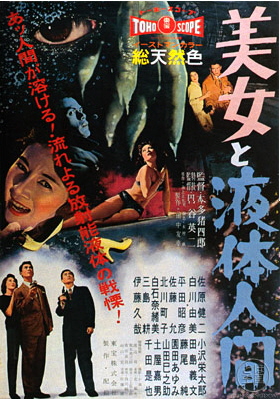
The H-Man (aka The Beauty and the Liquid Man)


                                                               1958
                                                  Director: Ishiro Honda
                          Starring: Yumi Shirakawa, Kenji Sahara, Akihiko Hirata


One of director Ishiro Honda's finest films as well as one of the most horrifying sci fi features of the '50s.

Filmed in 1958, this was the first of Honda's unconnected "Mutated Man" trilogy (the other two being 1960's The Human Vapor and 1963's Matango aka Attack of the Mushroom People) and like the original Godzilla, had it's core sci fi story based on an actual incident. That being the Lucky Dragon 5, a tuna fishing boat which in 1954 had unwittingly drifted into nuclear fallout from the U.S.s Castle Bravo thermonuclear test in the bikini atoll. The fishermen were exposed to high levels of radiation and many subsequently died from the poisoning.

With this horrific story fresh in the local public's mind, it was used as a not so subtle plot device in relation to Godzilla's first appearance. Four years later, it was revisited even more blatantly in The H-Man. For this story, we have a fishing boat that drifts unwittingly into the center of an H-Bomb experiment. It's crew dissolves into liquid puddles of radioactive goop. "Transformed", these H-Men  attack other humans, dissolving them in order to survive. It is especially unsettling because these are former human beings now attacking and dissolving other humans. This gives it almost a faint cannibalism twist. At certain points, these "Liquid Monsters" (as so called in the English dubbed version) can form what look like vaguely human appearances, making things all the more uncomfortable.

Mixed into the main story is a pulpy and somewhat trashy underworld tale (complete with Cabaret dance numbers featuring the gorgeous and scantily clad Yumi Shurikawa). This plot devise had been used previously (1949's The Invisible Man Appears) and since (Dogora, the Space Monster and Ghidrah, the Three Headed Monster, both from 1964), but this is perhaps the only time where the material was treated in such an adult manner (the other films mentioned tended to play the Cops and Robbers scenario as mostly tongue in cheek). The combination of the two stories may not exactly seem to mesh, but this was a popular combo for local audiences. With it's garish colors and suggestive cinematography, it comes off as an irresistible Neo Noir.

Featuring some of the most memorable special effects of Eiji Tsuburaya's career, The H-Man ranks as the best "blob" movie ever made. As much as I enjoyed the Steve McQueen starrer (coincidentally released the same year), it can't hold a candle to Honda's neon soaked vision.

                                                        ***1/2 / ****                                   


Thursday, October 6, 2011

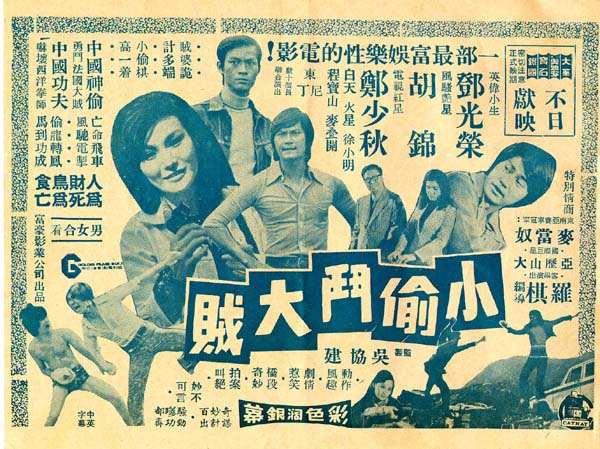
The Rats (aka The Rats of Hong Kong)


                                                               1973
                                                     Director: Law Kei
                            Starring: Alan Tang, Adam Cheng, Mars, Woo Gam

                                                           
This is a superior and ahead of it's time modern day action drama.

Set to a driving guitar riff, The Rats follows the misadventures of a gang of small time thieves. When not blowing what few dollars they have on women and gambling, they dream of that one big heist that would ultimately make them rich. That opportunity presents itself in the form of a major gangland exchange involving two gold filled cars. Concocting an impressive scheme involving a fake traffic stop, our "Rats" successfully acquire the golden autos. Not all goes as hoped however as they soon find themselves individually persued by the understandably irritated mobsters who themselves are being pressured into retrieving the gold by their even crankier American clients.

Lensed in 1973 and directed by Law Kei (who would later direct the positively insane Bruceploitation mess, The Dragon Lives Again), The Rats more than most other films from this period successfully manages to avoid the pitfalls of the subgenre and transitions it's modern day gangland story into an entertaining tale. Others from this period (even the good ones) tend to be grungy, depressing affairs with the emphasis on seedy and uninvolving melodrama. Here we are presented with a lively adventure that though downbeat, refuses to wallow in any of it's potential sweaty excesses. The main characters are all surprisingly likeable and personable and are given just enough character buildup to keep you caring about them without overdoing it. It is not action packed (the majority of the action being relegated to the second half), but it is consistently involving. When the action does come, it is of the fast and furious variety with several lively and energetic fights and stunts. Most surprising is it's car chases. They are ambitious and excitingly choreographed with the finale being on par with the best the genre has to offer.

The cast is an impressive one. Alan Tang (one of the more recognizable faces in early Hong Kong action cinema) plays the lead and has never been more charismatic. He is allowed a three dimensional role here and takes full advantage of it, projecting both power and vulnerability. Adam Cheng is so young here that he is practically unrecognizeable as Tang's second in command. I had a hard time believing that this was the same actor featured in Zu Warriors of the Magic Mountain and Gunmen. Future Jackie Chan alumni Mars is given more to do than in most other films I've seen him in and he practically steals the film. He is also the best fighter of this group so it's no surprise that his fight scenes are the most impressive. Being a stuntman, he is also given some amazing things to do on a motorcycle during the film's preliminary chase scene, possibly the highlight of the movie. The beautiful and ubiquitous Woo Gam is given arguably the choice part of her young career as the main gangster's treacherous squeeze/business associate. Her character is allowed to play off both sides with equal relish; belittling her partner for his carelessness and getting close to Tang only so that she can get him to devulge the whereabouts of the gold filled vehicles. It's a wonderfully juicy role.

The Rats really was a pleasant surprise. It manages to be both exciting and consistently involving while also being a genuinely fine piece of action cinema. It is one of the best Hong Kong films of the early 70s.

                                                      ***1/2 / ****


Friday, September 30, 2011

Aces Go Places 2 (aka Mad Mission Part 2: Aces Go Places)


                                                               1983
                                                   Director: Eric Tsang
                     Starring: Sam Hui, Karl Maka, Sylvia Chang, Yasuaki Kurata

                                                    
The immediate followup to the wildly successful Aces Go Places (which I reviewed some months ago) is not only my favorite in the series but it just may be the greatest action comedy ever to come out of Hong Kong.

The admittedly difficult to follow story picks up shortly after the first film ended. The Godfather (unseen in this film) is still furious at King Kong and Baldy for having stolen the diamonds (what he and the other charaters never realize is that they no longer have said diamonds). Since White Glove had failed him, he calls on the White House (!) to send their number one assassin, Filthy Harry (an unnamed white actoer who does a dead on Clint Eastwood impression) to kill our heroes. Back in Hong Kong (where the remaining 95% of the film takes place) King Kong finds himself repeatedly setup by a deceitful damsal who tricks him into robbing a bank. Fleeing from the cops, he interrupts Baldy and Ha Tung's wedding, leading to further bickering amongst the trio. In addition to Filthy Harry, Kong and Baldy find their trail dogged by a Japanese gangster (verteran Yasuaki Kurata in a memorably low key comedic turn) and must also deal with an escaped mental patient who's posing as an F.B.I. agent (hilariously played by Tsui Hark who nearly steals the film).

If the above plot description makes the film sound a bit disorienting, it's because it is. The story veers off in all kinds of directions that exist for the sole reason to hold the action and comedy together. Yet it all works and works wonderfully, thanks in no small part to the deft direction of Eric Tsang. Tsang did an excellent job on the first entry and manages to up the ante considerably here. For me, this film is ninety minutes of sheer joy as it breathlessly goes from one frentic setpiece to another. The fight scenes are an improvement (though admittedly they're still not at the level of what Jackie Chan and Smmo Hung were performing) and the car chases though pretty remarkable in the first, are improved ten fold here. The mid film chase alone (including backwards driving for much of it) is one of the greatest of it's type ever filmed. Then there are Filthy Harry's robots (yes, imagine Clint Eastwood with a pair of giant robots at his disposal). There is an entire sequence where Harry's giant bot battles Kong's army of small toy bots and it may be the highlight of the film (well for this robot loving fan, anyway).

But the heart of the film's enjoyment remains our ever loveable trio of mismatched heroes. Sam Hui, Karl Maka and Sylvia Chang have now grown into their roles and are a true joy to watch as they play off each other with a rare level of charm for this type of movie. They supply the film with it's soul and keep everything well grounded, despite the almost constant craziness that goes on around them.

Complete with the welcome return of the James Bond, whistling, fuzz guitar theme (as identifiable to this series as anything else), Aces Go Places 2 is an endlessly enjoyable and inventive farce. Easily one of my favorite films, I've watched this a dozen or so times over the years and it's still as fresh and enjoyable as the first time I viewed it. A desert island film to be sure.

                                                           **** / ****


Saturday, September 24, 2011

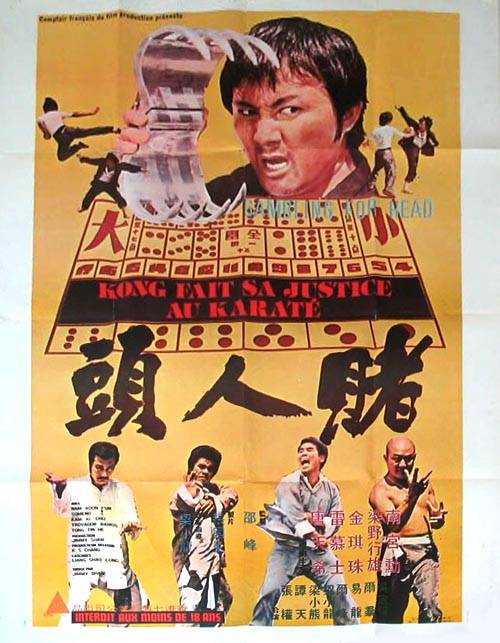
Gambling for Head


                                                             1975
                                                Director: Jimmy Shaw     
                        Starring: James Nam, Gam Kei Chu, Travador Ramos

                                                          
One of the many consistencies of early 70s Chinese martial arts films is that they include a gambling scene. To this day, I'm not sure why so many of them did, other than to serve as a way to advance the plot (which I guess is all the reason that's needed). But it wasn't until this incredible 1975 basher was unleashed on the good public that the entire crux of the story revolved around the ever present gambling den.

Gambling for Head tells the story of a poor fisherman whose wife dies giving birth to their child. Broke and jobless, he leaves his son in the care of his best friend as he seeks help from his uncle who lives in another town. When the baby grows gravely ill and needs hospitalization, the friend resorts to visiting a gambling hall in an attempt to raise money. When he looses his last dollar, he resorts to offering his head as currency. He looses that bet, too... Upon returning home, the fisherman finds his child dead and his friend murdered by the casino owned thugs (yes this is one DARK mamajama of a story). In a fit of understandable rage , he first murders the second, third and fourth in command (each a top fighter) and with their decapitated heads in a bag, marches to the gambling den to confront the boss.

Director Jimmy Shaw films the first half of this ferociously grim revenge tale in a circular manner, ala Citizen Kane or Pulp Fiction. It is a surprisingly ambitious move on Shaw's part and he manages to successfully pull it off. Throughout the first thirty minutes, we see our hero face off individually against a trio of his enemies. During each fight, there is a either a cutaway or splitscreen mirroring an incident at the casino which we have yet to see. It isn't until after these battles that we then flashback showing the full, horrific incident involving his friend at the casino (and some of this is indeed tough to watch). For the final thirty minutes, we are then brought up to speed as the enraged fisherman confronts the main boss. Though initially this technique may be a bit befuddling for first time viewers, it builds dramatically as a result and by the final freeze framed image, one is left feeling drained.

Starring in this harrowing film was "Mr. Rage" himself, James Nam. As I mentioned in my review of Thunderbolt Fist, few (if any) can convey anger and hatred like Nam. Usually relegated to villainous roles, here he makes for the ideal avenging hero. This in addition to some rather ugly and scary looking baddies, fuels the fight scenes wonderfully. The final twenty minute plus confrontation is as savagely intense as any I recall seeing, further fueled by unusual (and nasty) weaponry (the head baddie's lackeys use claw like devices that clamp around the enemy's arms and legs).

Gambling for Head emerges as a top notch late period basher that is a must for genre fans.

                                                             *** / ****