Monday, July 23, 2012

Valley of the Double Dragon (aka Kung Fu of Tai Kwan Do) (aka Fist Fighter)


                                                               1974
                                              Director: Ulysses Au Yeung
                    Starring: Kim Jin Pai, William Shiela, Robert Baker, Lin Chen Chi

                                                        
This unusual film takes place during Japan's occupation of China during WW2. A downed U.S. fighter pilot (William Shiela) forms an uneasy alliance with a small group of Chinese freedom fighters as they oppose the Japanese soldiers who have been pillaging the countryside along with help from a sadistic Nazi (Robert Baker).

A choppy, uneven, yet fairly entertaining affair, Valley of the Double Dragon marks the directorial debut of one Ulysses Au Yeung. The ubiquitous Ulysses had directed everything from straight kung fu fare (Thou Shall Not Kill... But Once, Ming Patriots) to classic wuxia (Big Land Flying Eagles which may be his masterpiece), to slapsticky fu comedy (Three Shaolin Musketeers) and even dabbled in Brucesploitation (Bruce Lee, We Miss You). VOTDD displays the same energetic, swift paced, rough and ready style of filmmaking that seems to be the director's forte.

Ultimately, the film is probably most notable for it's cast. Star Kim Jin Pai is a real life 10th degree Hap Ki Do black belt who starred in several films during the early '70s, most noteably the hard to find (dubbed in Englsh, at any rate) cult favorite, 'The Mandarin' (aka Godfathers of Hong Kong). Easily the best martial artist in the film, Kim throws a mean screen kick and his battles tend to generate most of the movie's excitment. This I believe is the one and only film appearance by William Shiela. Very unusual to see a black actor in a Chinese production of this vintage. He appears to be a real life martial artist (from what I can tell, anyway) and does a competent enough job in the action scenes. The role also allows (or possibly forces, depending on your point of view) him to be all over the place in the thesping department. Starting off as angry, viscious and distrustful of his soon to be Guerilla allies, he soon enough finds himself in disguise as Guan Yu (!) as the team attempts to infiltrate the Japanese HQ. Robert Baker's claim to fame was playing the Russian 'Petrov' in Bruce Lee's Fist of Fury. This film marks Baker's second and apparently last film role. This bit of casting alone is enough to spark interest for genre fans. Unfortunately, Baker's 'acting' as the ruthless, sadistic Nazi is just as stiff as it was in the Lee film. Not that much was actually required of him for the role; his familiar appearance alone seemed to do the job. This film also marks the debut of the beautiful and talented Lin Chen Chi. An intense actress with a perpetually wild look in her eyes, I first took notice of Lin's work in Tsui Hark's 1980 rage filled masterpiece, 'Dangerous Encounters of the First Kind'. Sadly she's underutilized in this film as her character is relegated mostly to onlooker status (not a fighter, it seems). Still she manages to stand out in every scene she's in.

All in all Valley of the Double Dragon is certainly no Eastern Condors (what is?), but it is a worthwhile low budget 70s style war-fu oddity. I'll admit I went into this one thinking it's sole interest would be it's cast, but I came away enjoying it a bit more than I thought I would. Worth tracking down.

                                                               **1/2 / ****


Sunday, July 15, 2012

Cobra


                                                                1981
                                                 Director: Joseph Velasco
                            Starring: Bruce Lei, Peter Chen Lau, Leong Wong Ko

                                                         
Not only is this curiosity not to be confused with the Stallone movie of the same name, it's also not to be confused as a Bruce Le (as in one 'E', as in Bruce clone) starring vehicle. Though billed as the star of the film and his face plastered all over various posters (the one used here excluded) and vhs boxes, he is nowhere to be found. Apparently, this Indonesia lensed flick decided to use his name purely as a selling point as his films were popular there at the time (can you imagine; a second rate Bruce Lee clone falsely billed in order to lure patrons?!). The actual star is Bruce Lei and no, this isn't the actor who's better known as Dragon Lee. That was a different 'Lei'. I'm not sure who this Bruce Lei is, possibly Steve Lee of the film 'Steel Fisted Dragon'. Maybe, maybe not...

Onto our story: 'Bruce' is the favorite pupil of your typical white beard, kindly old teacher/father figure. He is also in love with the old man's daughter (of course). The old master is killed one night by an unidentified assassin who calls himself, The Cobra . His dying wish is that his daughter and fave pupil forget everything, get married and move away. And believe it or not, that's what they do! They have a kid and 'Bruce' lands a job after unwittingly fending off a few gangsters who were harassing a rival. His job is basically as a collector/enforcer, something he does not enjoy. He let's his boss know he's quitting after one last job (you know exactly where this is heading). The 'job' is botched and the boss sends his goons to kidnap 'Bruce's' wife and child. It goes horribly wrong amd the two are accidentally killed (this scene is one of the more excrutiating ones that I have seen in a kung fu film of this vintage). This sets the tone for the last thirty minutes as an enraged 'Bruce' lays waste to the rheumatism stricken boss and his henchmen (the top assassin turns out to be identical twin brothers leading to the line, "So the two of you were born on the same day and you will die on the same day!"). It ain't over 'till it's over however as at the last instance, The Cobra (whom 'Bruce' and the audience had basically forgotten about) shows up to finish what was started (or something like that), leading to a final freeze framed 'surprise' ending that will cause one to shake their heads in disbelief (if they weren't already doing so, that is).

If the above plot rundown makes this film sound like some careless, convoluted mess, that's because it is. 'Credit' one Joseph Velasco who among many others, directed such no budget wonders as the entertaining 'Ninja Strikes Back' and the notorious 'Clones of Bruce Lee' (both of which DO star Bruce Le). He lends his typical air of incomprehension to this film. Still, this wobbly inducing affair does have a minor cult following and this is mostly due to the gory carnage on display in the last half hour. After a slow, somber buildup, Velasco just seems to say screw it and pile on the martial arts mayhem in earnest. This sudden change in tone only adds to the confusion, but in a so bad, it's good kinda way.

Again, not positive who star Bruce Lei actually is, but he is a decent Lee-alike. Not the best I've seen, but not the worst either and he does display some half decent acting chops to go along with his welcomed  subdued Lee impression. His underplaying of the role actually lends some genuine drama to the proceedings.

As these Bruce Lee clone flicks go, I found Cobra strangely intriguing. It's jarring shifts in tone combined with the gore filled climatic battles and nonsensical final shot (to say nothing of it's score, which at one point incorporates a muzak instrumental version of 'Bridge Over Troubled Water'!) make it ideal viewing for insomniacs everywhere.

                                                                   **1/2 / ****


Tuesday, July 10, 2012

Invisible Man vs the Human Fly


                                                              1957
                                             Director: Mitsuo Murayama
                        Starring: Ryugi Shinagawa, Yoshiro Kitahara, Joji Tsurumi

                                                    
This is the followup to Daiei's 'The Invisible Man' (which I have yet to see) and is quite a quirky little sci fi thriller.

Tokyo is gripped with a series of murders committed by an unseen madman who kills his victims with a knife plunged through the heart. The only apparent warning sign being a buzzing sound preceeding the attack. The police are baffled. One officer quips that the murders could only be committed by an invisible man. Little does he (or the others) realize that through light ray technology, such a being has already been created. Unfortunately once someone is transformed, there is no way to bring him back without causing a fatal form of cancer. The actual killer however, is using a different method; an invention that can allow him to shrink to the size of a fly. The noise that accompanies our deranged mini murderer is because (as science points out, cough!), that creatures when they are shrunk to a small enough size, can float through the air while creating a natural humming sound.  Once the killer is found out, it is reasoned that only an invisible man can stop him. But will anyone be brave enough to alow himself to be transformed knowing he cannot become visible again?

Invisible Man vs the Human Fly is a fairly fun watch, but not quite as much fun as it ought to be. Director Mitsuo Murayama lensed this little pic as something akin to a police procedural. As such, the film has a rather deadpan 'Dragnet' like feel that is at odds with the decidedly loopy sci fi story. Though it does manage a faint B/W Film Noir quality that is appreciated, one need only watch Ishiro Honda's 'The H-Man' (lensed in vibrant color) to see how unnecessarily subdued much of the material is presented here. The effects are pretty cool; the human fly is just that, a man shrunk down to the size of a fly (with no insect-like appendages which would appear in the U.S.s 'The Fly') and just sort of floats around (and above and under) things, waiting to strike. The Invisible Man ('People" actually, at the risk of giving too much away) is compentent, but is not up to the level achieved by John Fulton in Universal's 1933 classic. Arguably the best 'special effect' on display takes place during the nightclub sequences featuring various scantily clad dancers (again predating 'H-Man') that most definitely livened up the lethargic first half. It also led to the film's most amusing moment as our villainous Human Fly having an unhealthy obsession with one of the dancers, buzzes around her while she relaxes in her dressing room only to find himself mildly swatted by the unsuspecting hottie.

Recommended mostly for Kaiju completists. Fortunately, I tend to fall into that category myself, so all is well.

                                                                    **1/2 / ****


Friday, June 29, 2012

Django the Bastard (aka The Stranger's Gundown)


                                                              1969
                                               Director: Sergio Garrone
                       Starring: Anthony Steffen, Paolo Gozlino, Luciano Rossi


Sergio Corbucci's 'Django' was a huge hit in 1966. So popular and infuential was this seminal Spaghetti Western that lesser filmmakers began cranking out dozens of unrelated films with the name Django in an attempt to cash in on the original's success (isn't this always the case in every genre?). Many of these were pretty listless but a few were actually quite good (though none could touch Corbucci's original). This one, Django the Bastard is one of the best and a fine 'Gothic' Western as well.

After the credits (complete with appropriately stirring theme track) unspool, we are treated to one of the great opening sequences in the genre. A mysterious gunman (black hat and poncho, the whole nine yards) enters a small town carrying a handmade, wooden cross with the name Sam Hawkins on it as well as the current date. Hawkins emerges from an inn and recognizes the man as Django. Django quickly kills Hawkins who drops dead conveniently right in front of the cross specially made for him. As flashbacks slowly reveal, Django was a Union soldier whos squad was betrayed on  the battfield by a trio of Generals who sold them out to the Yanks. Left for dead, Django has re emerged to wreak his vengeance upon the three traitors. But is it actually Django or his ghost that they find themselves up against?

Director Sergio Garrone is not in the same league with the other Sergios (Leone and Corbucci) but under the right circumstance, he can coax himself into presenting a decent film. Django the Bastard is probably his best. The early scenes in particular are extremely well done. Throughout the early portion, it is suggested that Django is an invincible, avenging spirit (a Grim Reaper of sorts) and the comeuppance wrought upon each of the wrongdoers has a wonderfull air of the supernatural. It almost feels as much like a Giallo as it does an Italo Western. Unfortunately, the second half of the film can't quite keep the sense of dread going. The story bogs down slightly as we are introduced to one the Generals' evil, twisted brother (an admittedly creepy character) who among other incidentals takes a bit away from the central story. Things do wrap up with a well executed final one on one showdown, but some of the power is lost by that point.

As Django, Anthony Steffen is his usual solemn self. He isn't bad here, but his interpretation of Django falls short (as all other Djangos do) of Franco Nero's definitive portrayal. Of course, it was a little difficult for me to judge his perf here as the English dubbing on the print I saw was just terrible.

Overall, Django the Bastard makes for a good entry in the faux Django series. If you like atmosphere in your Spaghetti Westerns, then this one is for you.

                                                              *** / ****


Tuesday, June 19, 2012

The Righteous Fist (aka Furious Ultimatum)


                                                               1972
                                               Director: Wong Hung Cheung
                    Starring: Wong Yung, Chiao Chiao, Man Chung San, Lee Chi Lun


One of the best early Bashers I've seen yet. This is a genre that I've been catching up with as of late (having been exposed mostly to post 1975 kung fu movies for the early part of my life) and it has been an eye opening experience. Though this genre (like any other) has had it's share of clunkers, if you dig around long enough, you will find your efforts rewarded. That's already happened for me several times, many of which I've blogged about here. Then I come across a film like The Righteous Fist and the bar is unexpectedly raised.

Wong Yung stars as a C.I.D. agent who returns home under the guise of practicing medicine. His true motive is to arrest a notorious drug runner who has set up shop and is using his martial arts school as a front. He and his gang are also threatening to take over our hero's old school. Knowing of his true identity, the villians kidnap the agent's sister in order to force his hand. Adding to the situation is the presence of a traitor who is attempting to help the gang take over by framing our hero and discrediting him in the eyes of their teacher.

What we have is all the necessary ingredients for a successful early Basher; good school, vs bad school, good school's master's daughter in love with our hero, bad school hiring ringer in the form of a Japanese master 'with Hitler mustache', traiter in good school secretly working for bad school, main character learning the iron palm... but rarely has it all come together as sharply as it has here. Credit the inspired direction from genre vet Wong Hung Cheung for keeping things so lively and focused (contrast his work here with the lacklustre lensing he performed in the following year's Heroine Susan: Sisiter of the Shangtung Boxer).

Wong fills the film with unusal and sometimes unexpected flourishes. the 'learning the iron palm' sequence for instance, is shown in a very casual and innocuous way that lulls the audience into almost forgetting about it. This makes it all the more startling at the climax where our hero stabs his fingers into the various baddies, even through one unlucky bastards' hands (shown in gruesomely realistic closeup). Equally unexpected is the slain master's daughter and heroic love interest's (well played by Chiao Chiao) cathartic vengeance. Her character had been portrayed as well reasoned and under control throughout. Only during the finale where she finally catches up to the head baddie does she unleash her rage, stabbing the horrified king pin more than a dozen times with a knife. Wong also supplies the film with several peculiar character and situational quirks. The Japanese karate expert for instance is portrayed not as a huge and fierce warrior, but as a decidedly slight fellow with an apparent phlegm problem. It somehow makes his lethal skills seem all the more formidable (the slight build that is, the phlegm thing I probably could have done without). But by far the most bizarro idea comes late in the film. Just prior to the heroes' raid on the bad school, the decision was made to reduce their ranks by singling out and elimminating the biggest threat; a huge, nearly indestructable mountain of a man (portrayed by resident Hong Kong giant, Cheng Fu Hung) who's weakness is his propensity to get rip roaring drunk. Their way of getting rid of him? Why, by waiting until one particular night when he goes off on his own and gets especially smashed. Our heroes dress up as haunted zombie spirits and scare him literally to death! This scene, like the other bizarre moments is played absolutely straight faced. In a lesser effort, a scene like this could grind the proceedings to a halt, but here somehow, some way it works in spite of itself.

The Righteous Fist is a superior Basher and comes highly recommended.

                                                           *** / ****


Monday, June 11, 2012

The Mercenary (aka A Professional Gun)


                                                               1968
                                                 Director: Sergio Corbucci
                             Starring: Franco Nero, Tony Musante, Jack Palance

                                                        
It took nearly one hundred posts before I finally got around to reviewing a film from one of my favorite genres, the Spaghetti Western. In an attempt to come up with something semi-special, I'll review Segio Corbucci's The Mercenary, a film that until recently was only available in muddy Pan & Scan transfers. Finally a proper Widescreen print surfaced and now the film can be seen for what it is, one of the great director's finest films.

The Mercenary is part of the Spaghetti Western subgenre known as the Political Western which began in 1966 with 'Bullet for the General' (another top Spaghetti Western) and effectively reached it's finale in 1971 with Sergio Leone's 'Duck, You Sucker". Corbucci's entry though not as widely available (here in the States, anyway), is revealed to be every bit as vital and entertaining as it's better known brethren, if not more so.

Our film follows the adventures of  Sergei Kowalski (an excellent Franco Nero), a Polish mercenary who is hired by the treacherous Col. Alfonso Garcia (Edwardo Fajardo) to protect his shipments of mined silver. Along the way, he meets up with Paco Roman (Tony Musante), a mine worker and Revolutionary wannabe. They become tentative allies (Roman to liberate his people and Kowalski because he sees a way to make money in the deal). Further complicating matters is Curly (Jack Palance who admittedly is not given enough to do), a professional thief (and one who seems to wield considerable ploitical power) who is determined to steal the silver for himself.

I have been a big fan of Sergio Corbucci ever since I first saw Django (still my favorite of his and fave Spaghetti Western after Good, the Bad and the Ugly) and was ecstatic that The Mercanery was finally given the full dvd treatment. I now would rank this right up there with Django and The Great Silence as one of his three best. This was easily his largest production up to this point (the 'shooting down the plane' sequence alone looks like it was more costly than the entire budget afforded for Django). It is also his most impressive looking film and it is especially impressive that he tells this typically long and winding tale in just over half the length of time that Leone used to tell his epics and without any loss of character development or epic 'feel'. Corbucci also injects this film with a welcome dose of humor, something his earlier Westerns lacked. One especially memorable running gag is Kowalski's habit of using literally anything to strike a match (a man's teeth, a dead and hung man's boot, even a hooker's breast!). The highlight of the picture has to be the amazing duel in the bullfighting ring between Paco (in clown makeup) and Curly. Though borrowing a bit from the famed three way battle at the climax of Good the Bad and the Ugly, Corbucci still creates an almost unbearable amount of tension (both are forced to stand back to back as Kowalski hits a bell three times with the two being instructed to draw on the third gong). It is one of the great moments in the history of the genre.

Interestingly, Corbucci virtually remade The Mercenary two years later as Companeros (this time Franco Nero plays a 'Swede' as opposed to a 'Pole' with no discernable difference in the charater). Though that film ups the ante in both the action and humor while also giving the film a more downbeat finale (both films very much reflective of the 'times' and 'attitudes' in which they were made) it doesn't quite reach the majestic heights of his first 'Politico' piece.

                                                            ***1/2 / ****


Monday, June 4, 2012

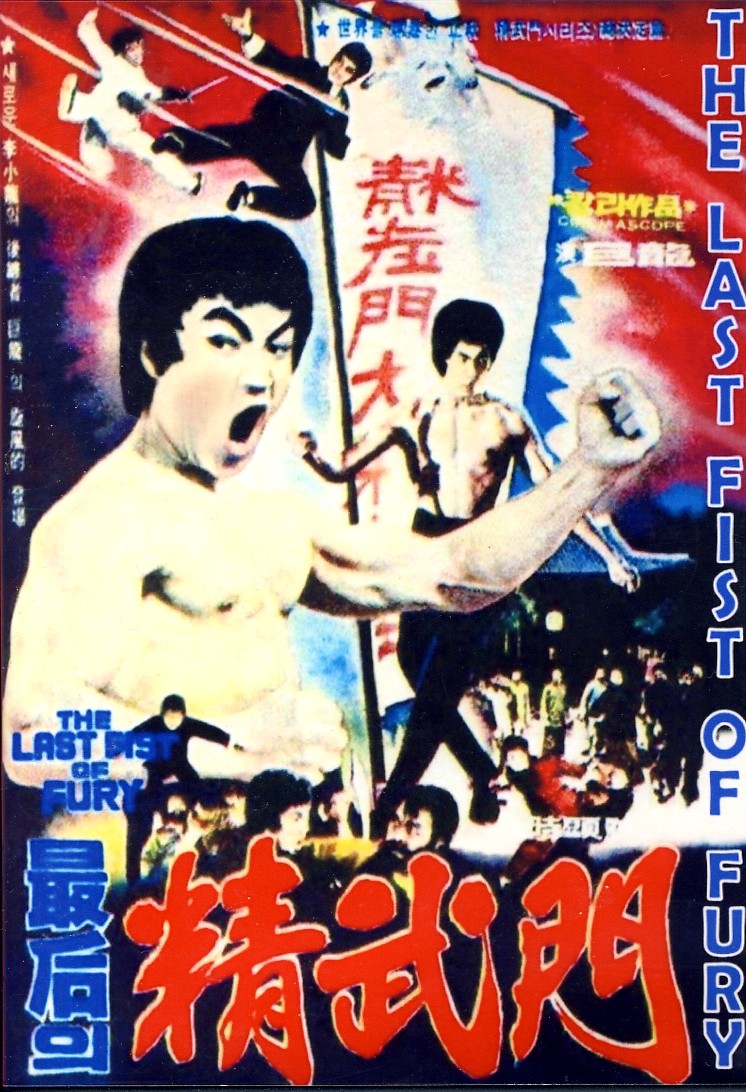
The Last Fist of Fury


                                                              1977
                                               Director: Shi Hyeon Kim
                        Starring: Dragon Lee, Martin Chui Man-Fooi, Lee Ye Min,

                                                            
That most infamous of all kung fu subgenres, the Bruceploitation. After the untimely death of The Little Dragon, filmmakers all across Asia scrambled to find his 'replacement'. Sadly, this meant that if you looked even looked vaguely like the real (and deceased)  mccoy, and could punch and kick reasonably well, you were in line to be, "The Next Bruce Lee!". Usually this resulted in poor performances in subpar (often just plain awful) Lee-remakes. The first Lee-alike (Bruce Li aka Ho Chung To) was at least a good actor/fighter who was ultimately able to shake the Lee image. As for the rest, well they basically fell somewhere between mediocre and terrible. Then out of Korea came one in particular who could only be described as 'Psychotronic'. Welcome to the world of Dragon Lee.

An accomplished Hap Ki Do and Tae Kwan Do practitioner, Lee broke into movies due to his resemblence (at the time, anyway) to Bruce. He actually looks like Bruce on 'roids with a head that seems too big for the rest of his body. This nearly cartoonish appearance combined with his waaayyy over the top mugging and yelling made nearly every film he appeared in to be akin to some freakish funhouse-like charachature. There are many kung fu enthusists who strongly dislike him and his films, claiming he is the very worst of the Lee-alikes. I on the other hand, find the majority of his pics to be great, goofy, energetic fun. The Last Fist of Fury is his first starring vehicle and for my money, it's one of his most enjoyable.

Dragon Lee plays Shau Lung, a student of the Ching Wu school who while practicing in the mountains under the watch of his white bearded old master, is shocked to learn of the death of top student Dai Tung. Tung was challenged by a rival Japanese school and was murdered through treachery (isn't that always the case?). The Japanese school then took over Ching Wu, fearful of it's growing number of students. Shau wastes little time heading back into town (all the while being followed by a mysterious white garbed ninja like presence) and thrashing the Japanese karate experts en route to reclaiming the Ching Wu school. He is challenged by the Japanese leader, Yasheka and after having to deal with the Japanese's secret extending sword, Shau defeats him, killing him in the process. However, the Japanese school has an ace up their sleeve when they call upon Greuber, a mysterious half Japanese/half German fighter to personally finish off Shau and the rest of the Ching Wu students.

Originally seen in butchered form as part of the 'Documentary' (ripoff, actually) The Real Bruce Lee, The Last Fist of Fury still seems incomplete even in this incarnation. At first, I attributed the choppy editing to the filmmakers but then came across a scene that seems to start at the tail end of  a lengthy dialogue exchange. Whether or not a more complete print surfaces (or even exists) doesn't really matter for as it stands, this one of the great, bizzarro, unintentional (?) kung fu comedies I have seen. It easily rivals the (intended) laughs that were generated by the Zuckers Bruce riff in Kentucky Fried Movie. It's hard to put my finger on exactly what makes this film such a wobbly inducing experience; Lee's maniacal Bruce mimickry, the odd plotting (disposing of the presumed main bad guy halfway through only to introduce an even greater menace who looks like he stepped out of some cockeyed Spaghetti Western), the strange choice of weapons (Grueber has a pair of what look like metalic frizbees), the appearance, disappearance and reappearance of the mysterious white ninja character... it's just one of those experiences where for better or worse, you know you're watching something 'special'.

The Last Fists of Fury is a hoot  It comes highly recommended to Dragon Lee fans (you know who you are!).

                                                               **1/2 / ****