Thursday, September 12, 2013

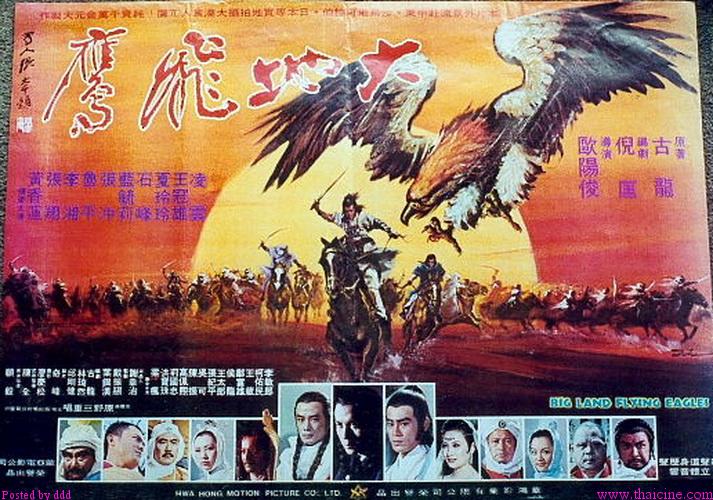
Big Land Flying Eagles


1978
Director: Ulysses Au Yeung
Starring: Wong Goon Hung (Champ Wang), Lin Yung, Paul Chang Chung, Shi Feng

 Here we have an interesting, well crafted and visually unique wuxia film.

The complicated plot centers on traveling swordsman supreme, Xiao Fong ( the awesomely labeled Champ Wang). Xiao killed the son of local warlord, Lee Sang. Lee was charged with the delivery of 3,000,000 in gold which has mysteriously vanished. Lee marks Xiao for death, but Xiao finds himself in an unlikely alliance with another reputable swordsman, Killer Eagle as well as a band of traveling Mongolian warrior/traders. Despite his target's new found comrades, Lee sends all manner of esoteric assassins out after him. Xiao for his part, gets involved with a mysterious woman who has manged to make many an enemy in her own right.

I'll admit that I've not seen as many classic wuxia movies as I have other types of Chinese martial arts/action films. Part of the reason is that many of the ones that I have seen tended to be overly complex and narratively confusing, at least to this Westerner.  'Big Land Flying Eagles' could easily have succomed to these same problems, but thanks to some sharp direction from Ulysses Au Yeung (a favorite independent 70s director responsible for several gems, most notably the previously reviewed 'Thou Shall Not Kill... But Once), I had little problem dissecting the complex story and characters. This is also one of the most visually striking martial arts films I've seen from this period. Shot entirely in the desert, the film creates an epic feel in spite of it's low budget. Almost a kind of 'Lawrence of Arabia'-lite (O.K. extremely lite). It's very pleasing to the eyes and creates a wonderful semi-surreal atmosphere throughout. It's quite a quirkily plotted film as well, including one of the most strikingly bizarre dramatic sequences to be found in any genre film; Xiao Fong and his mysterious squeeze are hiding out in a deserted shack when they find themselves surrounded by Lee Sang's gang. Xiao realizes that since he killed Lee's son, Lee wants the two young lovers to procriate (as in right there in the shack) and will wait one year for their child to be born and then have it killed in order to exact revenge. The shack is then ripped down by the unseen assassins so that they could see what they're doing! Xiao and the woman do not react to their sudden lack of shack. They continue to lie there in the night time forest and smile at the silliness of this failed plan. It plays just as outrageously matter-of-fact as it reads.

Featuring a terrific action sequence finale, 'Big Land Flying Eagles' is a wonderful min-epic of 70s martial arts cinema and comes highly recommended.


Rating: 9/10


Wednesday, August 28, 2013

Marked for Murder


1994
Director: Lee Chiu, Tenky Tin Kai Man
Starring: David Lam Wai, Ben Lam Kwok Bun, Liang Chia Jen

This appears to be a peace offering from Hong Kong to the Mainland due to the up and coming change of ownership. Judging by the several unfamiliar faces and two directors, this may even be a Hong Kong/Mainland co-production. Whatever the case may be, it's a little seen pic that combines unfortunate and unnecessary comedic characters with some of the most blistering 80s style action to be had in the 90s.

A bank employee witnesses the murder of his boss at the hands of a powerful Yakuza gang and it's nearly invincible leader (Ben Lam). On the run, he is guarded by a male and female member of a Mainland Task Force who in turn, must cooperate with a bumbling Hong Kong detective (David Lam).

Assuming that this production is indeed Hong Kong's attempt to make nice with China, then it represents a fair amount of overkill in that department. The two Mainland operatives are portrayed as calm, smooth and highly efficient while their H.K. counterpart (the usually reliable David Lam who is miscast here) is in the words of his superior, kind of dumb. That he has also an annoying, shrewish wife certaintly doesn't help matters. In fact, when said wife is ultimately kidnapped by the Yakuza, I was hoping that would be the last we heard of the character (no such luck). The goofiness also extends to our hero's superior/ brother in-law (a thankless non-fighting role for "Beardy" Liang Chia Jen who perhaps tellingly, is clean shaven for the role). Is is a credit to both Lam and Liang that their characters still manage to retain their charm and likeability (if less so, their dignity) throughout. Always relaible Ben Lam is suitably menacing and imposing as the head Yakuza.

Despite the uneven treatment of it's characters, the film really comes alive when it counts in the spectacular and plentiful action scenes. After personally suffering several years worth of wire fu films, 1994 turned out to be quite a renaissance in the stay on the ground and fight department. So fantastic is the action here that I can forgive much (but not all) of what goes on in between. There are others who might be less forgiving.


Rating: 5/10


Friday, August 23, 2013

Pendekar Liar


1982
Director: Dasri Yacob
Starring: Willy Dozan (Billy Chong), Winnie Aditya Suherman, Sutrisno Widjaya

 Billy Chong, the kung fu superstar that almost was. I became an instant fan of the Indonesian born actor ever since my first T.V. exposure back in the mid 80s. One of the most accomplished fighters the martial arts film world has ever seen coupled with natural charisma and strong screen presence, I was always curious why his star never rose beyond the also-ran group. Depending on my mood, I might even go so far as to say he is my favorite fighter/actor not named Bruce Lee. Unfortunately until only a few years ago, I had zero knowledge of Billy's post HK work (to the point where I wasn't sure he even had any). That however, didn't disuade me from penning an embarsassingly incomplete article about him in an old issue of Asian Cult Cinema magazine, circa 1999. I have since discovered that the reason (the given reason, anyway) for his abrupt departure was the disappointing commercial failure of the big budgeted, Sun Chung directed epic, 'Wind, Forest, Fire, Mountain' (aka A Fistful of Talons). He returned to his home country and did indeed resume a movie and T.V. career there under his birth name, Willy Dozan. 'Pendekar Liar' I believe was the first of them.

For the second time in a row, I'm attempting to critique a film that does not contain English subtitles. The previous blog entry, 'Jiu-Jitu' was relatively easy since the storyline was so simple and straightforward. 'Pendekar Liar' proved to be a tad more difficult. Fortunately, I just recently came upon a plot rundown that I was able to translate into very broken English. Hey, better than nothing...

In the film, Billy plays an orphan named Annga (which somehow translates to "CyberNet"!) who has been raised since birth by an old martial arts expert named Cokro and taught the the martial art, Silat (I think). Time and time again Annga attempts and fails to defeat Cokro (reminicent of the teacher pupil scenes in Drunken Master and Chong's own Crystal Fist). Nevertheless, Annga is sent away (with Cokro's loving daughter in tow) to seek out his mother (it has to do with the necklace he's wearing) and solve the mystery of who killed his father.After many adventures (which allow Chong as many chances to fight as possible, most notably taking on a karate school and their ringer, a nearly indestructible fat woman). Annga discovers that it was Cokro himself who caused his family's death... or so he thinks. Cokro as it turns out, has an identical twin...

I've seen my share of Indonesian action/martial arts films of this vintage and entertaining as they are, the actual fight scenes tend to be below the level of those found in Hong Kong. 'Pendekar Liar' for the most part, bucks that trend with some well above average choreography and this is almost certaintly due it's established star. I'm not certain if Chong's participation extended to choreography but judging the heightened level of combat here, I think it's safe to assume that it did. The fights may not quite be as lightening fast as they were in his Hong Kong pics like 'Super Power', 'Kung Fu From Beyond the Grave', 'A Hard Way to Die' and  the aforementioned 'Fistful of Talons', but they're close. Sure, Billy still appears here as a man amongst boys, but it's clear that his incredible martial abilities rubbed off on the production.

If there was a letdown to be felt, then it was in the finale. Though it does work on a dramatic level regarding the dual identity revelation (if anything, the drama and comedy are both handeled with more subtle flare here than in it's H.K. counterparts), it falls somewhat flat in the action department (the big deal being Billy's newly mastered technique which causes him to give off a strobe effect similar to Bruce Lee's famous arm movments vs Petrov in 'Fist of Fury' or Nemuri's Full Moon Sword stance in the later 'Son of the Black Mass' films). But it became clear that Billy had to ease off against his opponent (picture Jackie Chan having a final confrontation against Yuen Siu Tien's evil twin rather than Hwang Jang Lee for the climax of Drunken Master and you'll get the idea) making it feel less exciting than it might have.

That aside, 'Pendekar Liar' is a great find for we Billy Chong fans among who had precious few H.K. vehicles to choose from. Now I'm off to hunt down the rest of Billy's homegrown product...


Rating: 5/10


Monday, August 12, 2013

Ju-Jitu (aka Jiu-Jitu vs Karate)


2010
Director: Hiroki Asai
Starring: Ryohei Sakai, Koji Nakamura, Chikaomi Miyamoto, Yi Nan, Yasuaki Kurata

A no-budget, shot on video pic from Japan that just happens to contain some of the finest and most realistic empty handed combat sequences ever lensed.

The story is one big, hoary cliche about a nasty karate school challenging a noble jiu-jitsu dojo. Compounding the over simplistic story is some embarassing overacting from the villains and bland, near non-acting from the heroes, leading to some unintended laughs where there should have been tense drama. This however isn't surprising when you realize that real martial artists were used for all the main parts and they quite obviously never went to a thesping class.

But never mind any of that, 'Jiu Jitu' is all about the plentiful fighting and training scenes and are they ever an eyeful. Long time genre vet Yasuaki Kurata oversaw the project, producing and choreographing it as well as playing the wise jiu-jitsu sensei. Even in his 60s, Kurata has lost none of his physical prowess or screen presence. Star Ryohei Sakai may not quite cut it in the dramatic scenes, but once the combat comes into play, he "switches on" like the best of them and you believe he's the real deal (which essentially, he is).

The action is at a consistently high level throughout, but Kurata and director Hiroki Asai save the best for the finale. The near fifteen minute (!) showdown between Sakai's jiu-jitsu style and the karate school's top student (played by Koji Nakamura) is an absolutely blistering, exhausting tour de force that just may be the single finest one on one bout ever commited to film (er, video). So btutal, so thorough and so  draining is this bout that it left me gasping... and then rewatching it just to make sure it held up on repeat viewings (it most cetaintly does).

For all of the film's shortcomings, the final bout in 'Jiu-Jitu' automatically elevates it to recommended status.


Rating: 5/10


Here you can watch the final bout and judge whether or not I exaggerated about just how incredible it is:


Saturday, August 3, 2013

A Punch to Revenge


1989
Director: Lee Chiu
Starring: Ben Lam, Yukari Oshima, Eddy Ko, Chan Ging

Along with 'Close Escape' (reviewed elsewhere in this blog), this was another early Yukari Oshima vehicle I first rented at a Korean-owned store, circa 1990. Yet unlike the previous film, my memories of this one were not as sharp. Perhaps it was the melodramatic story (compounded with the expected giant Korean subtitles which obscured the english ones) that turned me off. Or perhaps it was that The Osh was not involved in the finale (hopefully that isn't too big of a spoiler) or maybe that my brain was on overload with this stuff at that point. Whatever the reason, I was pretty dismissive of this one at the time. It wasn't until I nabbed a better print a few years back (with legible subs) that I was finally able to appreciate 'A Punch to Revenge' and now consider it one of the better examples of late '80s HK action.

Fan (Yukari) is a HK social worker (!) who's client, Tsang (Eddy Ko) is a cripple who lives a humiliating life with his wife who must loan herself out as a prostitute in order to pay the bills. In an attempt to better this situation, Tsang enlists his cousin and three cohorts from the Mainland to work for notorious ex-HK detective Ma (Chan Ging). They commit a jewel heist, but are double crossed by their would-be employer. Sergent Lee (Ben Lam) once Ma's protege, investigates and a chance meeting (and subsequent romantic involvement) with Fan provides an unexpected break in the case.

 One of the the things that really struck me about 'A Punch to Revenge' (honestly, no pun intended) was it's utter unpredictability. Although it essentially revolves around it's two leads, this is an ensemble piece; one with layers of characters (particularly villains) who's importance seemingly are always on the increase or decrease as the film's lucid story unfolds. More often than not, this sort of thing yields murky and unfocused results so on the occasion where it's done correctly, it's all the more rewarding. The film is not exactly action packed but when the action does come, it is intensely gritty and nasty. In each skirmish, the outcome is always in doubt, making for some of the more white knuckled moments the genre has seen. The gore filled finale in particular, is about as uncomfortable (and yes, unpredictable) as it gets.

In the unlikely role of Fan the ass kicking social worker, Yukari Oshima is allowed one of her meatier roles. This was an attempt at softening her image a bit and she proved more than up to the challenge. The Osh displays genuine sweetness and vulnerability heretofore unseen in her previous work. It's also significant that of her three excellently staged fight scenes, only one (where she angrily trashes Ma's office and everyone in it) did she truly prevail and this allows a genuine concern for her character's well being throughout (though that said, there is nothing I enjoy watching more than my fave femme fighter in total control, mopping the floor with any and all wood-be opponents). Taking the lead in the film is the always reliable Ben Lam. An impressive kickboxer, Lam has been consistently effective whether playing Moon Lee's naive boyfriend in 'Dreaming the Reality' or as Stephan Chow's nearly indestructible rival in 'Love on Delivery' (to name just two). Here as the reckless police chief, he displays a quietly commanding demeaner and plays quite well off Yukari. They actually make for a charming and believable couple, here. Eddy Ko is also quite good in the sympathetic role of  Tsang who must endure his wife sleeping with clients for money (in their own apartment yet!) as well as the burden of caring for a severely retarded child (shockingly played by a  young boy obviously stricken in real life with cerebral paulsey). That such potentially heavy melodrama is handled so delicately and with such a casual lack of sentimenatality is a credit to director Lee Chiu who managed to avoid such potential pitfalls. This is an action film first and foremost and Chiu thankfully never lost sight of that.


Rating: 8/10


Saturday, July 20, 2013

Zen Master 6


1987
Director: Lo Lieh
Starring: Suen Gin Ming, Meng Chuan Sheng, Lok Yun, Fang Hua, Diang Wing,

I have always been a great admirer of Lo Lieh. One of the best and most dependable screen villains in the history of Hong Kong cinema (he was afterall among many other things, the original white haired villain, Pai Mei), it is extremely ironic that most viewers here in the West were first introduced the intense Indonesia native in the classic King Boxer (5 Fingers of Death) where he played the righteous and chaste hero. His list of screen credits is astonishingly long and varied, nearly encapsulating the whole of the genre itself. Not nearly so impressive is his scant list of directing credts. Starting with 1973's 'Devil and Angel', Lo has a mere nine titles in a twenty year span. This includes the cult favorite, 'Clan of the White Lotus for the Shaw Bros. and the curious brain horror flick, 'The Black Magic With Buddha. In 1987 he delivered his best effort, 'Zen Master 6'; a Hong Kong/Mainland co-production that melds the best of both territories.

In the film, the Abbott of Shaolin is dying and must name a successor among his young disciples. The short-tempered San Sau (Meng Chuan Sheng) seems the favorite, but the Abbott chooses the  more thoughtful Wai Nam (Suen Gin Ming) and sends his prized pupil out to find enlightenment. The furious San Sau recklessly sends his brothers out to track him down. Meranwhile on his travels, Wai meets a potential love interest (Lok Yun) and helps a small costal village fend off invading pirates.

I had very limited info on this rarity (what little I had heard was positive) so I approached it with cautious optimism. What I came away with was one of the best Shaolin films I'd ever had the pleasure of watching.  While hardly original (it's basic story right down to the outcome of it's proposed love story was lifted wholesale from 'The Shaolin Temple' starring Jet Lee), never have all the familiar elements come together quite so sharply as here. From the strong, understated performances to the swift and assured pacing (particularly in the oddly placed, yet totally agreeable pirate segment) to the excellent, creative, state of the art fight choreography, there is nary a false note struck through any of it's economic 93 min running time. The finale in particular where Wai Nam and San Sau settle their differences once and for all, is one of the best and most satisfying one on one duels in all of kung fu cinema.

'Zen Master 6' was obviously a labor of love for Lo Lieh (he also produced the epic) and it payed off with a derivitaive, yet thunderously satisfying  martial arts epic that has thus far gone criminally underseen.


Rating: 8/10


Sunday, July 14, 2013

Ac Kartallar (Starving Eagles)


1984
Director: Cetin Inanc
Starring: Nihat Yigit, Mecit Yavuz, Nilgun, Sarayli

 Another of director Cetin Inanc's no-budget whacky wonders, this one designed specifically to showcase the talents of Bruce Lee lookalike (yes, a Turkish Lee-alike) Nihat Yigit. From what I know about him, Yigit was a Bruce Lee fan and took up martial arts in 1973 (the year Lee died). He apparently studied all manner of fighting arts including Kung Fu, Karate and Tae Kwan Do. After competing in various tournaments throughout Europe, he drew the attention of Inanc who saw strong possibilities in him as a screen fighter. His uncanny physical resemblence to Bruce at the time also could not be ignored (all the more remarkable as Yigit isn't Asian; perhaps Lee's few German genes made more of a difference than initially thought?). After featuring him as the main villain opposite Cuneyt Arkin in Olumsuz and Son Savascisi (he was shown a fair amount of respect in both as he was the only opponent to have ever even remotely given Arkin a tough time of it), Inanc decided it was time to star him in his very own Lee-clone epic (never mind the fact that the subgenre had died many years before).

The story; while visiting Turkey from Japan, a noted martial arts master is murdered by a rival clan that also happens to heroin smugglers. The slain master's top three students get to the bottom of things and take revenge. That's a about it.

Inanc does his best to meld the typical kung fu revenge story with his own patented sense of sheer insanity and it ultimately makes for a mixed bag of entertainment. On one level, you have bad nartial arts moviemaking at it's finest and funniest what with exaggerated closeups, swiped music from Enter the Dragon (and in the finale, Raiders of the Lost Ark) bewildering edits, overracting villains and some hilariously awkward fight choreography (one moment in particular had me on the floor as Yigit attempts to swing two men around ala Lee in Fist of Fury, but doesn't quite pull it off). Yet as entertaining as it all is, there is also a slight feeling of frustration since genuine martial artists were used and several fight scenes tend to be unnecessarily sped up (and i'm not talking slightly as in Sammo Hung's preferred method, I'm talking about full blown Benny Hill-like shenanigans). In the typical Inanc/Cuneyt Arkin epic, this is fine, but here it and the poor choreography tend to take away from the combatants considerable talents. Fortunately, this "technique" is for the most part eliminated in the second half, as if Inanc realized halfway through that severely undercranking his fighters wasn't necessary here.

At the center of it is a very entertaining performance from Yigit. His Lee impression is spot-on, more so than many of his Chinese counterparts and his excellent martial arts skills are placed on full view here. Watching Yigit do his thing, one wishes that he were given more opportunities, perhaps in a Hong Kong lensed production with top flight fight choreographers. 

Overall, Ac Kartallar is a fun time and will appeal to both Turkish Cult fans and Bruceploitation enthusiasts alike.


Rating: 5/10